







 The Celtic Cycling Circle
 Cycling alongside the Grand Union Canal
 5 Essential Items to Take with You on Your First Cycling Tour
 Favorite Cycling Destinations: Sardinia
 Pamir to Karakoram- cycling the highways on the roof of the world
 4 Wheels 2 Hearts 1 World - A Day in Our lives
 Koga E-Worldtraveller - e-bike review
 Ten tips for tandem cycle touring
 colmandsamstreks - Two Beginners in France
 Cycling in Denmark
With over 11,000 kilometres of marked cycle routes, most of which are on cycle paths away from the traffic or on traffic free roads or tracks we just don't understand why more people don't tour in Denmark, it is just so relaxing to ride without the hassle of traffic. We know that it doesn't quite have the scenery of Norway or the Alps but it still has some very pleasant and interesting countryside to travel through and if you are interested in Viking history and archaeology it is a must and the people are so friendly and welcoming. Although some of the Danish towns are nothing to write home about most of the villages are pretty with their lovely white painted churches and immaculately kept churchyards. One thing that the Danish do well apart from the pastries, open sandwiches and good beer is their museums. They have created some great reconstructions of their Viking heritage with people living as Vikings in the reconstructed Viking long houses and settlements over the summer months, re-enacting Viking life with blacksmiths, carpenters and people making Viking food. Some of the best museums are the Ribe Viking Center, the Trelleborg Viking Fortress and the Viking Ship Museum at Roskilde.
Cycle Routes
Denmark is quite a cycle friendly nation and has a wide and extensive network of over 11,000 kilometres of cycle routes throughout the country. There are long distance national routes, regional cycle routes and local cycle routes which are very clearly marked. There are cycle paths on most major roads and in most towns, these are sometimes partitioned edges of the actual road although the width is a lot more generous than in Britain. Be aware that in some regions the cycle routes quite often use unmade up tracks with gravel surfaces and wider width tyres might be advisable although not essential.
Most of the cycle paths that run alongside main roads are well laid tarmac paths and good to ride on and are well maintained. If you are lucky you might find yourself on an old railway line which has been utilized as a cycle path like Route 29 between Havbro - Aars - Nibe which takes you away from the roads through some delightful countryside, this is an excellent ride with easy gradients.
 Cycling along the 15km Strand on cycle route 1 between Blokhus and Løkken, North Jutland. |
 Cycling through the Bunken forest, North Jutland. |
|
 |

|
The National Cycle Route sign. |
The Regional Cycle Route sign. |
The Local Cycle Route sign. |

National Cycle Routes
There are 11 main National Cycle Routes that run across Denmark and you can find a map of routes at ruter.dk. If you click on the 'Open the full map' link it will open the map in full screen and if you click on a route a pop up will appear on the left with a brief description of the route and links to view the route details and a link to download a gpx file of the route.
Campsites
There are numerous campsites in Denmark and you are seldom far from one. The sites are generally all of a good standard and are rated according to the Danish Camping Board star system of 1 - 5 stars according to the facilities offered. As follows:
- 1 star - minimum standards i.e. running water,toilets,at least one shower and one electric shaver socket.
- 2 star - minimum of 1 shower for every 25 pitches, a kitchen with hot water and a hot plate for every 50 pitches, as well as a playground for children and to be within 2 km of a grocery store.
- 3 star - must include hot water in the wash basins, a communal lounge, a larger play area, nursing rooms for babies and sinks or washing machines for laundry and be within 1 km of a grocery store.
- 4 star - these offer first class facilities with such things as saunas, solarium etc.
- 5 star - You name it it's got it site, tropical leisure pools, computer play-worlds for kids etc.
Prices do vary with the star rating and by high or low season but for a 3 star site in high season would be about 60 -95 kr per adult a night and 30 - 45 kr per child.
There is a book called 'Camping Danmark' which lists all the campsites with descriptions in English. This is available from tourist bureaus, bookshops and campsites. More information on the campsites in Denmark is available at DK Camping.
By Danish law all campsites have to provide a kitchen for cooking your own meals. This saved squatting around on the grass to cook and was brilliant for when it was chucking it down with rain, however they don't always provide anywhere to sit down and eat your meal! Oh well you can't ask for every thing.

Typical Danish camping Cabin
Most campsites have huts or cabins for hire these can sleep from 4 - 6 people depending on size. These can be hired by the night or at weekly rates and accommodation can vary depending on price. A one night stay in a 4 bed basic hut would cost @ 580 - 690DKr which for 4 persons is a little bit more expensive than camping. We have used the huts on one occasion due to arriving late after a torrential day of rain and finding a flooded campsite!. We were lucky there was was one available that night as in high season they are nearly always booked up in advance. A basic hut usually will have bunk beds (you will need your own bedding/sleeping bags), table and a small stove, pans, plates, mugs and cutlery. There is no sink, toilet or running water and any ablutions are done using the normal campsite facilities. Most sites offer the more basic cabins but some sites have cabins that are much more spacious and luxurious with fitted kitchens, toilets, proper beds, TV etc. obviously the price increases pro rata.
Nature Camp Sites
According to the Danish Cyclist Federation nature camps have become extremely popular, apparently there are over 600 farmers throughout the country that offer camp sites at a very low cost, and the sites are for hikers and cyclists only. The purpose of nature camps is to provide cyclists and hikers with new places to camp, where they will come in closer contact with nature. A book with addresses is available from the Danish Cyclist Federation
In Denmark there are also the 'Teldsplats' or 'Primitive overnatningspladser' or 'Shelterplads' these are basic bivouac sites, they are marked on the Danish tourist board cycling maps with a scout style tent icon rather than the wigwam style icon of the main campsites. Transportation to the accommodation, shelter and tent areas must be done without the use of a motor. So you have to arrive either by foot, by bike, by horse or by canoe, kayak or dinghy. They are usually off the road in small woods and generally have a hand pump for water, a fire place and an earth closet. Some even have sleeping huts as well. The price for an overnight stay, shelter and tent is max. 30 kr. night. There are also some free bivouac sites (teltningsområder) around the country. These usually have very few or no facilities, there is some information on this Danish site www.friluftsraadet.dk.
You can find an interactive map showing the Primitive overnatningspladser at the 'Ud i naturen' site. In the top right of the site you will see a dark green rectangle saying 'Kort'. Click on that and it will take you to an interactive map showing the locations of the sites. You will need to select the region and type of overnating that you want to see in the filter list on the right hand dialogue box on the map. If you then click on an icon on the map more details links will appear in a dialogue box at the bottom left of the map which will take you to a page with more information of the overnighting site.
 Alternatively there is an iOS & Android app called 'Shelter' which is free to download. This app uses the google map API to show you where all the 'Shelters' and small tents sites are in Denmark. Using the GPS in your phone it will assess your location and center the map on your location. You can then zoom in and out and select either the google maps or Google satellite imagery to show the exact location of the site. If you click on the shelter icon it brings up information on that site although you do need a data connection to access it. Unfortunately the information is in Danish (I think the developer is working on other language versions) this isn't such a problem as we highlighted the text and copied it and dropped it into Google translate.
Maps
The Danish Cyclists’ Federation and Danish Cycling Tourism 1:100,000 Cycle touring maps -
Although these maps are relatively expensive they are very detailed and show all the national and local cycle routes and the usual tourist information symbols which have a translation in English. They are printed on waterproof paper and come in a card wallet. There are 8 maps that cover the whole of Denmark and they are available in most local Tourist Information Offices and bookshops.
 Kort 1 - Nordjylland cykelkort |
 Kort 2 - Vestjylland og Limfjordslandet cykelkort |
 Kort 3 - Sydjylland cykelkort |
 Kort 4 - Østjylland cykelkort |
 Kort 5 - Fyn cykelkort |
 Kort 6 -Nord- og Vestsjælland cykelkort |
 Kort 7 - Sydsjælland, Møn og Lolland-Falster cykelkort |
 Kort 8 - Bornholm cykelkort |
The Nordisk Korthandel 1:100,000 Cycle touring maps -
There are also cycle maps available from Nordisk Korthandel. These are again printed on waterproof paper and are pretty much indestructable. You can buy some of them with an accompanying guide book with tour suggestions. The tours are composed by Jens Erik Larsen, who has many years experience in the field. The tour suggestions describe, in a poetical way, the landscape and attractions you will see along the way. The book contains descriptions in Danish, English and German, and has small overview maps of the routes and attractions for each tour. The tours can be used as day trips or be composed into a touring route of your choosing. There is a good over view of all the maps on the Nordisk Korthandel site here.
 Cycle map of Northern Zealand |
 Cycle map of Southern Zealand including Lolland, Falster and Møn |
 Cycle map of Funen, with Ærø, Langeland and Als |
 Cycle map of Eastern Jutland |
 Cycle map Northern Jutland |
 Cycle map of Western Jutland |
 Cycle map of Southern Jutland |
 Cycle map of Bornholm |
Danish Cycle Route Planner
You can use the 'Naviki' online bicycle planner system. Obviously as with any online route planner it has its limitations and the route choices aren't always perfect. There is an associated free smartphone app, however if you want 'turn by turn' navigation or other features you have to pay for those as extras.
You can set your route on the planner by the following criteria:
- ‘Everyday’ – Cycle daily – quickly and via bicycle-friendly routes.
- ‘Leisure’ – Enjoy cycling in pleasant environments via official tracks.
- ‘Mountain bike’ – Unsealed surfaces, forest and country tracks, single trails.
- 'Shorter route' - For fast arrival on the shortest possible connection.
- ‘Racing bike’ – Smooth surfaces for fast cycling, including on side roads.
- ‘S-Pedelec’ – Tailor-made routes for fast e-bikes up to 30 mph.
You can set the map for various map types and for different 'Points of Interest' to show up on the route, useful for showing cafés or campsites etc. The planner gives you not only the distance and time of the route but an elevation diagram and the amount of climb and descent. Once you have created your route you can export it as a .kml, .ovi, .tcx or .gpx file. If you register with 'Naviki' you can save your routes and then they will automatically be available to the phone app.
GPS maps for Denmark
You can download maps for your GPS from the following sites:
Guides
Denmark a Lonely Planet travel survival kit - Published by Lonely Planet Publications ISBN 0-86442-330-6 A very useful guide to all things in Denmark.
Shops
Most of the larger villages in Denmark will have a small supermarket or shop, there are various stores such as the 'Dagli'Brugsen', Irma', 'Facta', 'Kvickly', 'Netto', 'Føtex' and 'Coop' to name a few that you might come across in Denmark. Denmark however is very curious when it comes to shop opening times, it is very much like Britain was a few years ago. Most of the local shops other than supermarkets are generally open from 9.00am to 5.30pm weekdays and on Saturdays close at midday or 1.00pm. It is unusual to find them open on a Sunday unless it is in a touristy area. The supermarkets however are open for long hours, even in smaller towns and villages, with most open 7 days a week, and from 7.00am until 8.00pm or 9.00pm on weekdays.
We have put together a Google map showing all the supermarkets and Fri Bikeshops and you can find it on this page of our website.
If you carry a GPS, a phone or tablet that has a mapping app such as Locus Map you can download a set of POI files for the supermarkets and stores in Denmark from the GPS For Alle site.
Ferries & Bridges
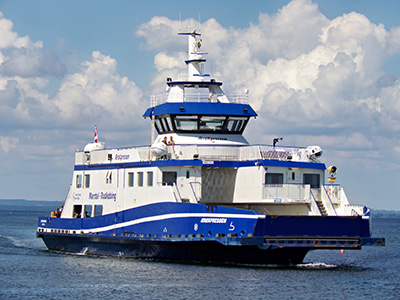 With Denmark being made up of 406 islands there are a lot of ferries that connect each of the islands. As these ferries are the only means of getting to and from some islands they usually have quite a regular service. The domestic ferries are susidised by the government to lower travel costs for island residents and boost local tourism.The Danish goverment makes the ferry travel costs comparable to driving the same distance on a regular land road.
You usually pay as a adult or child passenger and then there is a charge for your bicycle. Although on some routes the bikes can go free. Depending on the type of ferry some load bicycles before or after the cars on the car deck and there is a special place for bikes. Alternatively as on the Fanø ferry you load with the foot passengers pushing your bike onto the ferry and there are bike racks in the passenger area for your bikes.
THere are some bridges that connect the islands. Some have cycle lanes and you can cross by bike. However there are some that you cannot cross by bike such as :
- The Storebælt Bridge (Great Belt Bridge): Which connects the islands of Zealand and Funen. The alternative route is to catch a train.
- The Øresund Bridge : Which connects Denmark to Sweden. The alternative route is to catch a train.
- The Farø Bridges : On the E47 motorway that connects Zealand to Falster. The alternative route is to take National cycling route 7 along the northern bridge on the 153 between Vordingborg and Orehoved. Or to take National cycling route 9 across from Falster to the islands of Bogø and Møn and then on to Zealand.
 Trains & Buses
It is perfectly feasible to take your bikes on the Danish trains, we have used it several times (in fact it is the only way to get from Fyn to West Zealand if you are intending to cross at Kørsor or Nyborg) there is only one slight problem see our page 'Trains in Denmark' to find out. It very much depends on what type of train you travel on as to whether you pay for your bike or not. On most commuter trains bikes are allowed on for free but on the intercity trains you have to pay. There is a booklet from the DSB 'Bikes and Trains in Denmark' (in English) available at most stations. Contact DSB (The Danish State Railways) for more details. You can find a journey planner for the Danish railways here.
We understand that you can take bikes on most buses in Denmark. However as we haven't needed to use buses in Denmark we cannot comment on how this works and how easy it is to transport bikes on Danish buses.
If you need to catch a train or a bus there is a very useful Danish travel planner here. All you need to do is set your start and end destinations then set the options as to whether you wish to travel by bus or train and it will then show you the times and ticket prices. Don't forget to tick the bike option. By adjusting the options you can use it to compare the cost and time of a journey by bus or train. The site also has a departure board which you can set to any place and see the departures from any station or bus terminal.
Things to watch out for and note
- The high season for camping in Denmark is dependent on the school holidays and we found that by the end of the 3rd week of August they were starting to run down the stock in camp shops as the children had gone back to school.
- Although Denmark isn't a country with any high hills and is generally flat there are some areas that have heavily glaciated terrain such as south east Jutland, this can give rise to some short but steep hills!
- If you ride at night after sunset make sure that you have your bicycle lights working and on, if you don't you could face an on the spot fine of 500 Dkr.
Getting to Denmark from the UK
There are many flights to Copenhagen, Billund and Aarhus from the UK using various operators. For those who prefer not to fly then there are no direct ferry services to Denmark from the UK as sadly DFDS have stopped running any ferries now from Harwich to Esbjerg. The only alternative route is the ferry from Harwich to Hoek van Holland and then a train or buses to Denmark.
Contacts
- The Danish Tourist Board - General tourist information on Denmark. (in English)
- Dansk Cyklist Forbund - Danish Cyclists' Federation
- Danhostel Ribe - Bike rental and hostel accommodation in Ribe.
- DSB - The Danish State Railways. (in English)
- DK Camping - Information on the DK campsites in Denmark. (in English)
- Mols-linien - The ferry company operates the ferry routes between Odden-Ebeltoft and Odden-Aarhus and the Kalundborg-Aarhus route.
- Roskilde Tourist Information - General tourist information about Roskilde and it's surrounding area. (in English)
- The Map shop, 15 High Street, Upton-upon-Severn, Worcs. WR8 0HJ England
Tel: 01684-593146 Fax:01684-594559